Marin Theatre Company’s production of Harold Pinter’s Betrayal, directed by Carey Perloff, is exsemplary.
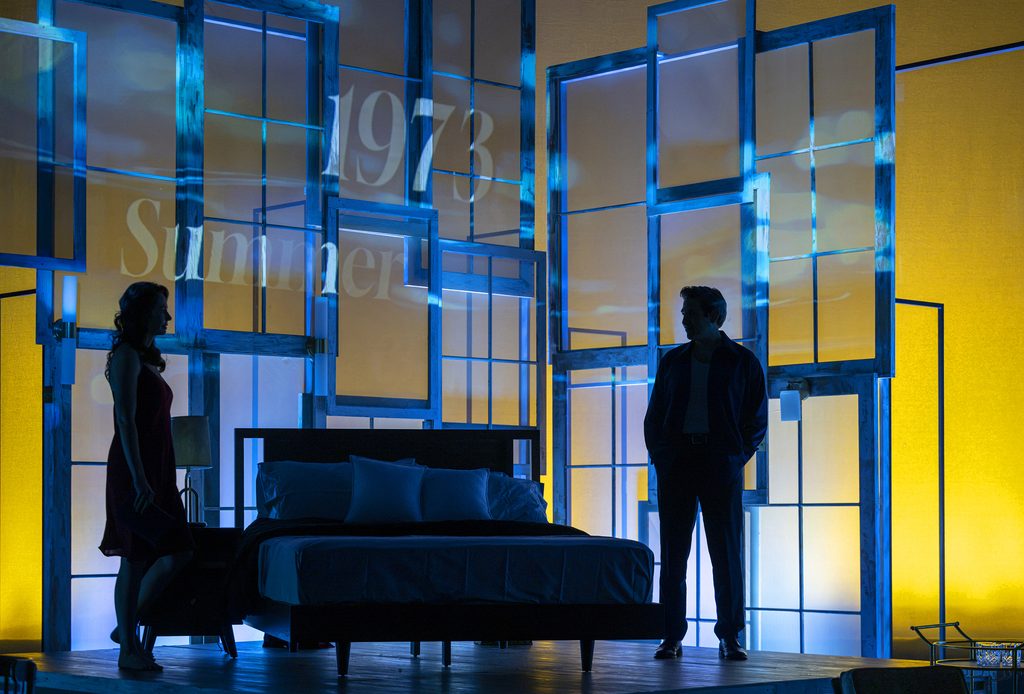
Emma-Liz sklar and Robert-Charlie Semine Photos by David Allen
Walking into the Marin Theare Company’s production, one could feel that the set is already speaking. White window frames and doors rise over the stage, tilted and stacked, as if someone took a house apart and put it back together out of order, which is exactly what Pinter does to time. The glass seems fused with the weather outside, and the videos beyond it change from scene to scene, so the sky always matches the mood in the room. Furniture sits far apart across the stage: a bed on one side, a rust sofa and armchair on the other, a lot of air between. The light is soft, and the whole thing is quiet. It’s the quiet of people who aren’t saying what they feel, and it’s powerful.
Carey Perloff’s production trusts that quiet. Her staging gives Harold Pinter’s script room to breathe. The play runs through nine scenes, backward from 1977 to 1968. We begin with the affair long dead and the marriage coming apart, then slide back to the party where it all started. Because we’ve seen the ruins first, every earlier scene glows a little warmer and has more emotional impact. Venice, 1973, is the hinge. Robert learns the truth and says almost nothing. Everything we’ve already watched grows out of that.
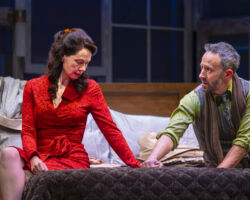
Emma-Liz Sklar, Jerry-Tasso Feldman photos by David Allen
What is very surprising is what happens between the lines. Pinter’s pauses aren’t rests. They’re shouts. Someone stops talking, and in the gap you hear the fear, the wanting, the wish to be asked one direct question.
Liz Sklar’s Emma wants to be noticed so badly she mistakes being pursued for being loved. Tasso Feldman’s Jerry is nervous and a little blind to what he’s doing, betraying Robert, his best friend, as surely as he betrays Emma. Charlie Semine’s Robert is the cool one. His calm asks nothing and forgives nothing, and that makes it cruel. Nicholas Moore’s waiter passes through like a small, steady touch of reality. The acting thoughout is superb, and the pauses land because each actor knows exactly what their character is holding back.
I left wondering what the play means in today’s Gen Z world, where marriage feels optional and loving more than one person is acceptable. Marriage, then and now: the customs have changed, and we’re even free to ask the hard questions. But what stirs underneath hasn’t changed. We still hunger for attention, need to be loved, and fear confronting each other and being rejected. Told forward, this is a story of exposure. Told in reverse, it’s a story of everything that could have been said and wasn’t.
“Betrayal,” is an excellent diversion from other plays, and it will stay with you. Great for conversations and further exploration. Don’t miss it.
“Betrayal “by Harold Pinter directed by Carey Perloff, set design by Yuki Izumihara, lighting by Russell Champa, sound by Fiona Sharkey, props by Jenna Foder, and costumes Jesse Amoroso, composer Jack Perla, At Marin Theatre Company, www.Marin Theatre.org till November 15 2026